
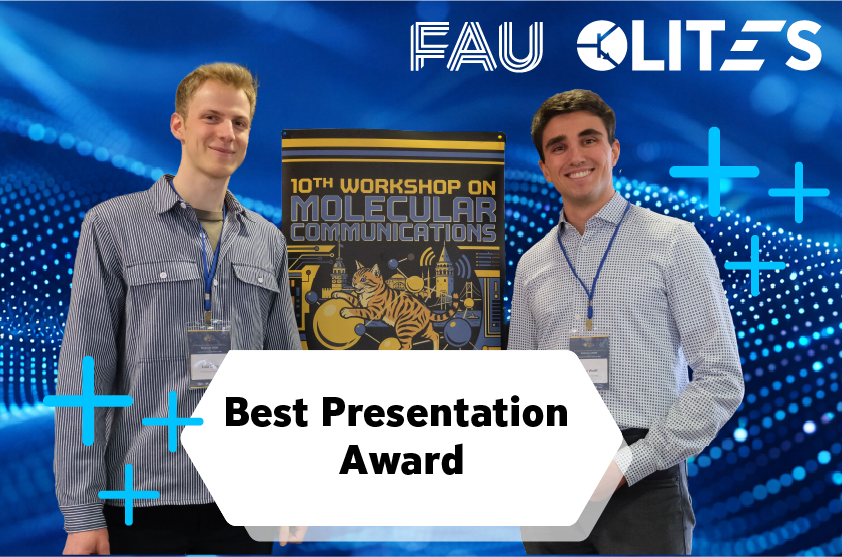
From April 14–17, 2026, the tenth Workshop on Molecular Communication was held at Koç University in Istanbul, Turkey. The anniversary marks a remarkable milestone for the field, which has evolved from a bold interdisciplinary vision into a vibrant, dynamic, and rapidly growing community. Over the course of the three workshop days, 28 papers were presented, offering an insightful overview of the current state of research in molecular communication. The extensive program was complemented by keynote talks and tutorials from leading researchers.
Since its beginnings, the field of molecular communication has drawn inspiration from a fundamental observation: nature has long relied on chemical signaling pathways as its primary medium for exchanging information. From intracellular protein cascades and intercellular calcium waves to organism-level pheromone signaling and volatile emissions from plants, biological systems demonstrate that communication at the molecular level can be remarkably efficient, adaptable, and robust. The research community has embraced this insight and developed theoretical frameworks, computational models, and experimental platforms that translate biological principles into engineered communication systems.
FAU was involved in seven of the papers presented, two of which from LITES in the area of testbeds and experimental platforms for molecular communication. The presentation by Paul Wolff of the paper titled “The Potential of Spatially Detecting SPIONs Using Multiple Sensor Coils” by P. Wolff, L.C.P. Wille, S. Lyer, and J. Kirchner was honored with the Best Presentation Award for the entire workshop.
The paper addresses the practical implementation of molecular communication based on magnetic nanoparticles known as SPIONs. The particles are synthesized by the Section of Experimental Oncology and Nanomedicine at Erlangen University Hospital and exhibit unique properties that make them promising for medical applications. They feature a magnetizable iron oxide core, which enables both external detection and external guidance of the particles. In addition, their surface can be functionalized to ensure biocompatibility, as well as to bind drugs directly to the nanoparticle. Taken together, this enables highly localized treatment of tumor tissue, since the particles can be both externally guided and monitored as drug carriers.